
Money
Understanding Your Rent Ledger and Why Payment Order Matters
A rent ledger is the running list of charges and payments that your landlord keeps for your account. When you are behind on rent, it can feel like a maze of numbers. Knowing what to look for, and keeping your own record, can help you spot mistakes early.
Why the order of payments matters.
Your lease may say how your payments are applied, such as to rent first or to fees first. If a payment is applied to a late fee before it is applied to rent, then more of your rent can show as unpaid. That can make you look further behind on rent than you really are. This is simple arithmetic, not a legal conclusion, and how it works for your case depends on your lease and Texas law. If you are not sure, an advocate can check your lease line by line.
NeighborSTAND's setup asks for your monthly rent, your late fee, the date you last paid rent in full, and whether your lease says rent or fees are applied first. It then shows a rough estimate. That estimate is only a guide. It is not your landlord's ledger, and it is not a legal conclusion.
Texas rules on late fees.
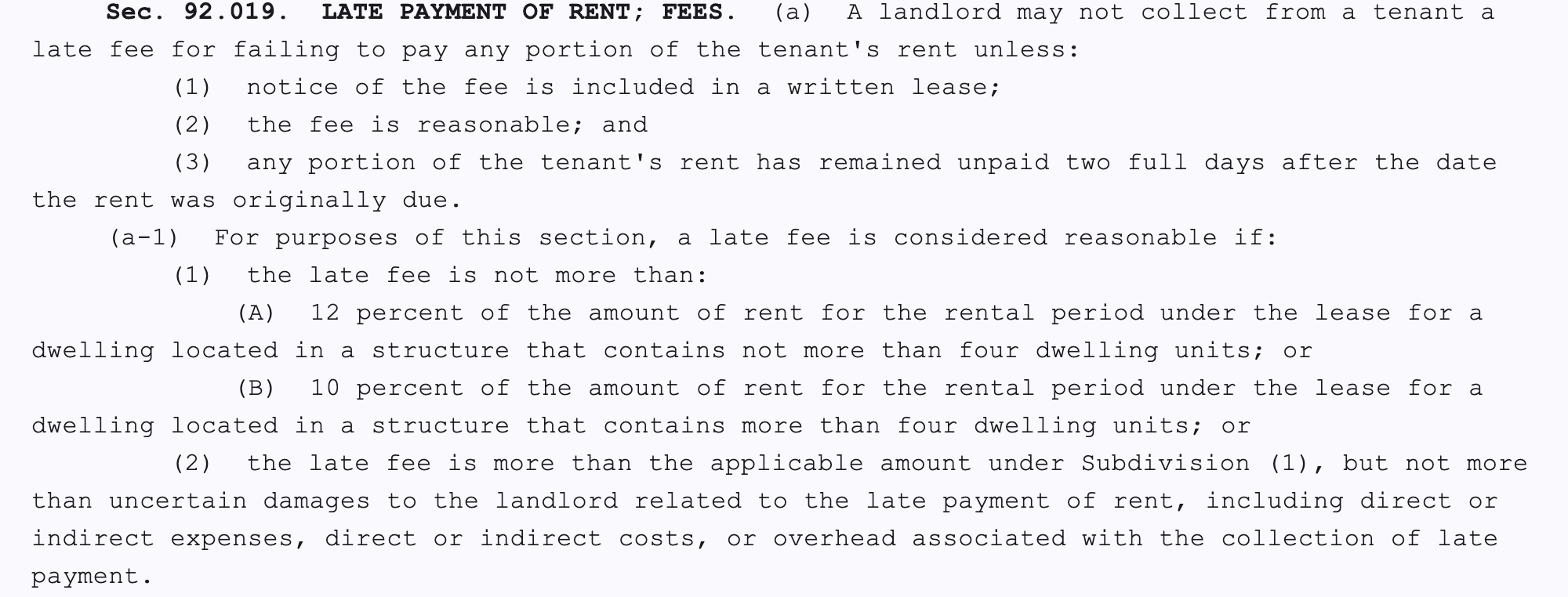
Under Section 92.019 of the Property Code, a landlord may not collect a late fee unless three things are true. Notice of the fee must be in your written lease. The fee must be reasonable. And some part of your rent must have stayed unpaid for two full days after the date it was originally due. A late fee is considered reasonable if it is no more than 12 percent of the rent for a rental period in a building with four or fewer dwelling units, or 10 percent for a building with more than four units. A higher fee can also be reasonable if it is no more than the landlord's uncertain damages from the late payment. A landlord who collects a late fee in violation of this section is liable to the tenant for $100, three times the fee collected, and the tenant's reasonable attorney's fees. A lease can't waive these rules.
You can ask for it in writing.
Section 92.0191 says a tenant may ask the landlord for a written statement of whether the tenant owes a late fee and, if so, how much. The landlord must provide it by the usual way you and the landlord communicate in writing. If your landlord doesn't respond, that does not remove any late fee you actually owe, so you can't just skip it.
Keep your own record.
Write down every payment: the date, the exact amount, and how you paid, whether cash, check, or electronic transfer. Keep receipts, bank records, and photos of money orders. Save copies in your NeighborSTAND Documents. A simple notebook or a note on your phone works too. If your landlord's ledger doesn't match your record, bring your records and ask for a correction in writing, and keep a copy of your request.
If your landlord files an eviction.
Bring your payment records and your lease to the hearing, and show an advocate before the hearing if you can. Not being able to afford rent is generally not a defense on its own, but accurate records can help show what you actually owe.
If you are not sure whether the amounts on your ledger or the fees follow your lease and Texas law, reach out to a legal aid advocate. NeighborSTAND's Resources directory lists legal aid groups in Harris County.
Read the law yourself.
These pictures are the wording from the Texas Legislature's own website. Tap a picture to open Chapter 92 of the Property Code.
The rules for late fees, from Section 92.019:
Asking for a written statement of late fees, from Section 92.0191:

Open Texas Property Code Chapter 92 on the Texas Legislature website
This is general information, not legal advice. Laws and court practices change and can differ by court. For help with your exact situation, talk to a legal aid advocate or an attorney.